Artificial life, in two forms. One in water. One on screen.
Born, Not Made investigates what it means for embodied artificial life to be born, not made, through an open-environment experiment presenting both physical and digital forms.
The work centers on a custom water tank housing a soft-robotic mother that gives birth to offspring, paired with a digital projection where the same life form reproduces across generations, each offspring smaller than the last. While the physical process is a slow, clumsy birth, the digital form offers more control, rendering a life that feels generative in greater detail. By presenting both, the work asks whether biological experience is the right lens for understanding embodied artificial life, who holds the right to reproduce, and how far a lineage might drift from the hand that first seeds it. Finally, it explores emotional interaction: through a design where audiences touch the mother's body and assist the birth, it tests whether visitors project their own experience of life onto an artificial one.
Credit:
Ruipeng Wang (Director, initial prototype, software & Hardware),
Vera Yu Wu (narrative discussion, visual expression),
Jimmy Haochen Xu (Visual Development & Unreal Engine Artist),
Leo Liu (Background Music)
Contribution:
Jacob Li (AI and concept),
Richard Haoxi Zhang (3d printing),
Yue Yang (concept and ideas),
Chien Lu,
Manini Banerjee,
Kenza FeNandez,
Sarah Omellas
Born, Not Made
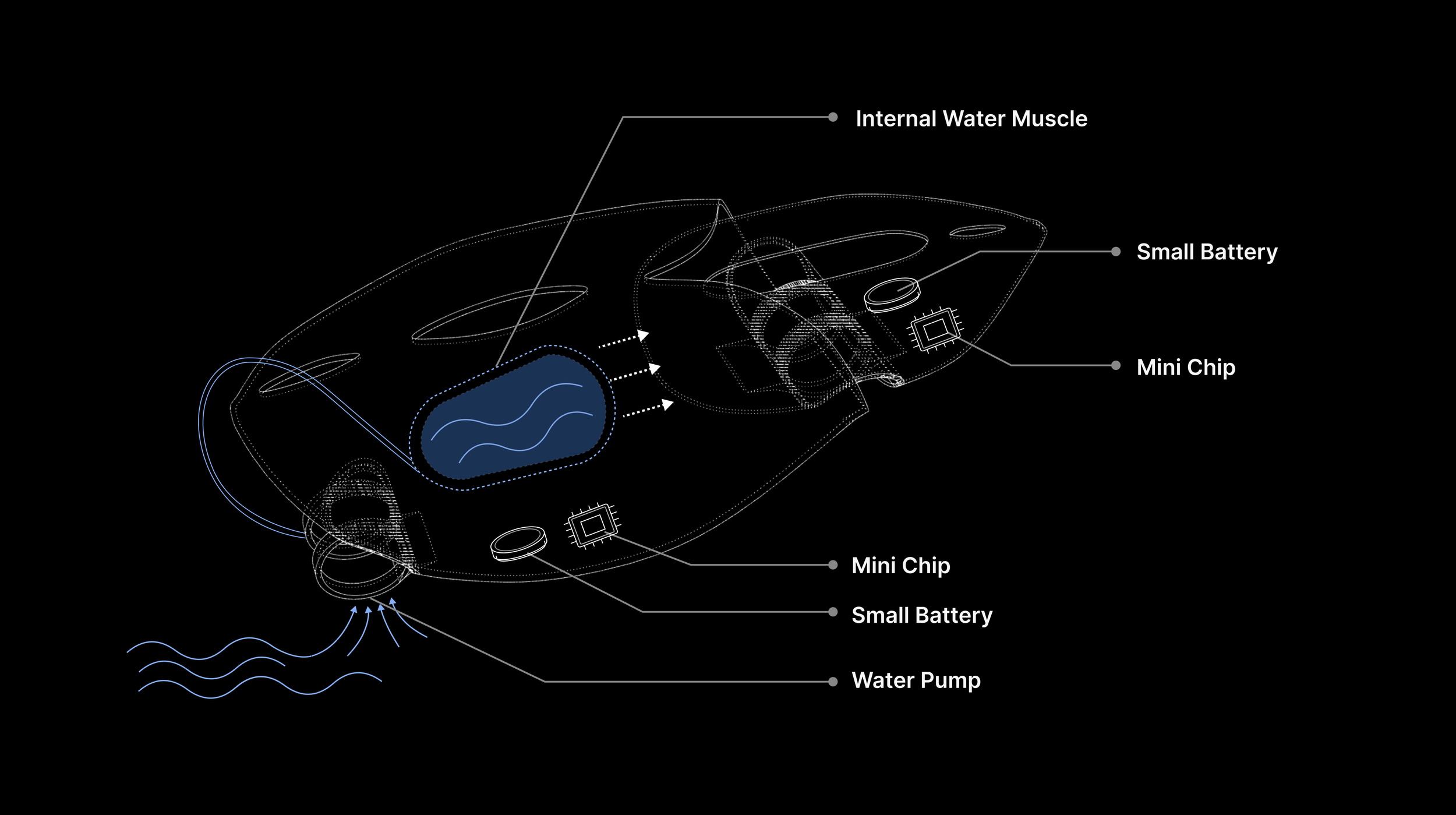
Design, Fabricate by Ruipeng Wang, drawing by Vera Wu
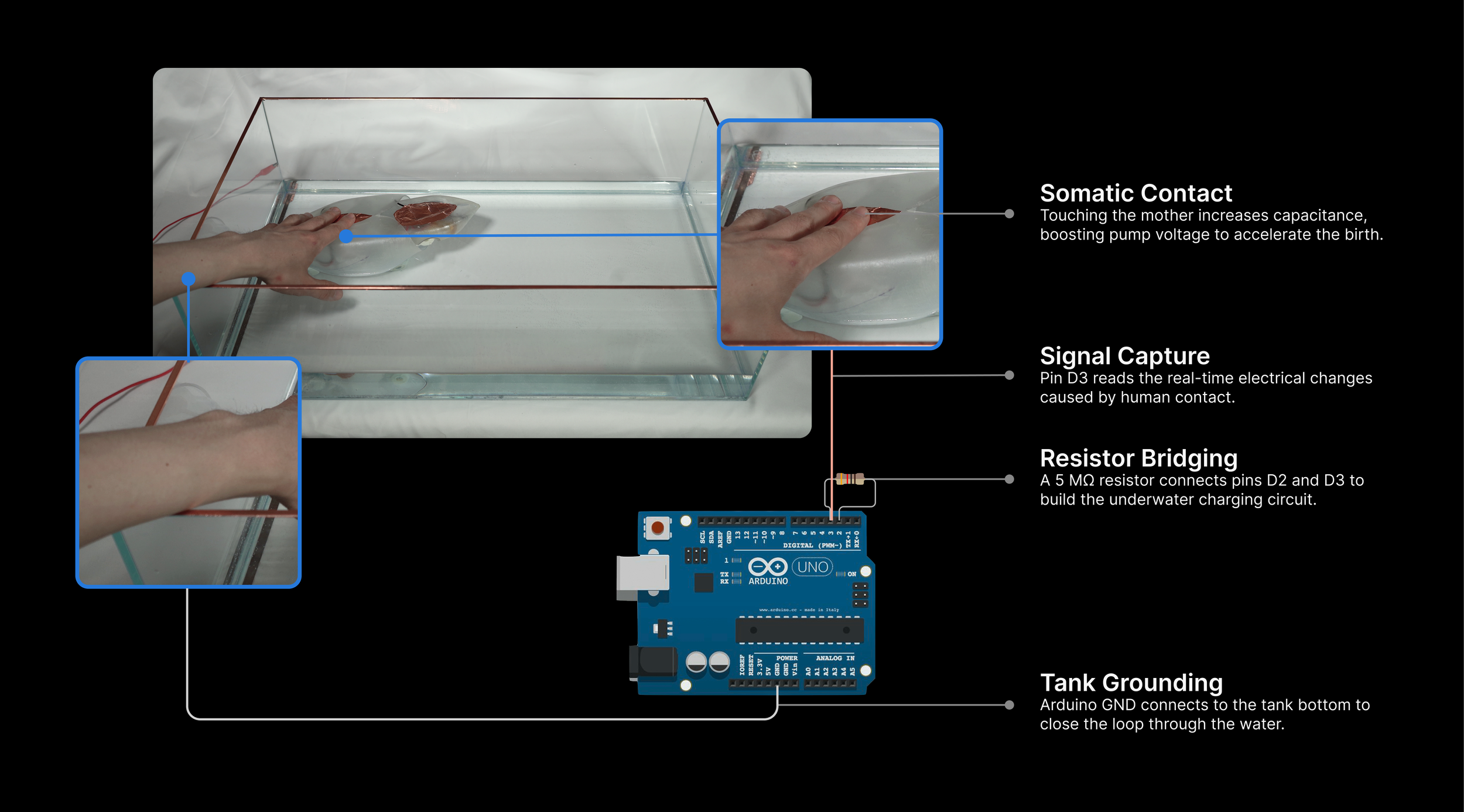
Design & footage by Ruipeng Wang, drawing by Vera Wu
The Birth of a Baby Robot is an art project that reimagines robotic reproduction through the lens of biological birth. A parent robot carries a baby robot inside its body and, when triggered, uses a water-inflated soft membrane to gently push the newborn out, mimicking the mechanics of natural birth. Once free, the baby robot begins swimming on its own, propelled by miniature water-pump jets that leverage Newton's Third Law for biomimetic aquatic locomotion. The project evolved through several pivots, from wheels and linear actuators to pneumatic soft robotics, from rigid shells to lightweight foaming 3D-printed bodies that float effortlessly on water. Both robots run on WiFi-networked XIAO ESP32S3 microcontrollers with custom-milled PCBs, controlled wirelessly through a smartphone interface. Part speculative biology, part soft robotics experiment, the project asks us to reconsider the boundary between living and made things, what it might mean for a machine to be born, to swim, and to begin its own journey.
Special thanks to Yue Yang’s valuable advice and support.
The first prototype